


Adobe Scan AI PDF Scanner, OCR
Adobe
I reach for Adobe Scan when a paper document needs to become a usable file before it gets lost under a pile of mail. It is a business-focused scanning app from Adobe, but I find it just as practical around a shared household: one person can capture a receipt, another can check a school form, and someone else can send a clean PDF to an office without searching for a printer. Its basic appeal is simple, yet the useful details are in the way it handles capture, text recognition, editing, and handoff.
The app is free to install and suitable for Everyone, which makes it approachable on a family tablet or a phone used by several people. It has built a substantial audience, with over 100 million installs and a 4.7 average from around 3 million ratings. Those figures suggest that it is not a niche scanner reserved for office specialists. My own view is more measured: it is excellent for turning everyday paper into organized digital documents, but it is not automatically the best choice for people who need advanced document management, a fully shared family workspace, or a completely separate identity for every household user.
What happens when a household shares one scanning phone
A realistic example is a kitchen table covered with paperwork. A parent may need to scan a permission form, a partner may want to preserve a warranty receipt, and a student may need to submit a signed page. With Adobe Scan, the phone camera becomes the starting point for all three tasks. I like that this removes the need to keep a bulky scanner nearby, especially when the document only needs to be captured once and sent onward.
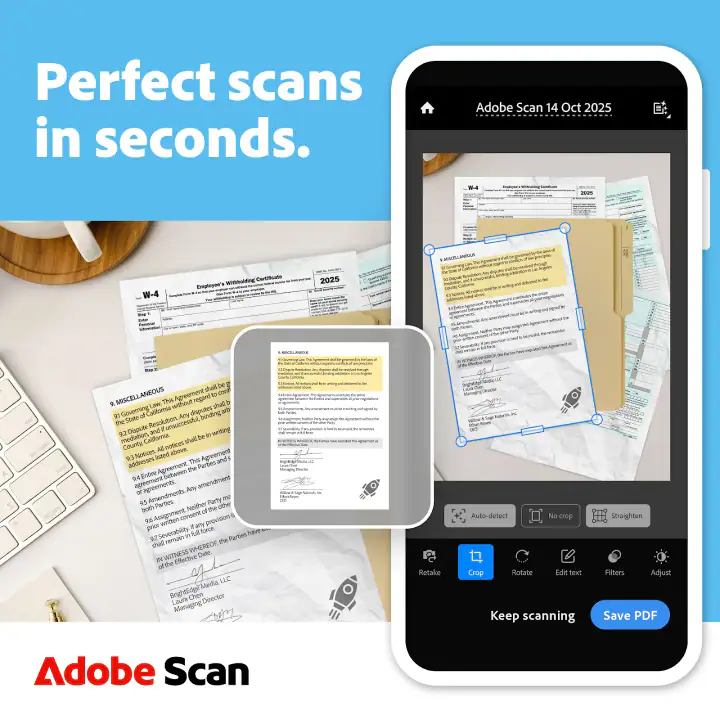
The camera view is designed around finding the edges of a page rather than asking the user to take an ordinary photograph and fix everything later. In good light, the process feels quick: place the page flat, let the app recognize it, review the result, and continue with another page if necessary. That distinction matters in a shared setting because different people may have very different patience levels. A confident user can move quickly, while a first-time user can still understand the basic flow without learning scanning jargon.
I find the app most useful for documents that are awkward to photograph directly. A slightly angled page can often be corrected into a more convincing rectangle, and the finished scan looks more like a document than a casual snapshot. Receipts, letters, forms, invoices, notes, and identification-related paperwork all benefit from that treatment. The result is easier to read on a screen and more suitable for sending to someone who was expecting a PDF.
Related News

Why WhatsApp Messenger Still Makes Everyday Communication Feel Easy

Jurassic World: The Game Is the Better Dino Tycoon for Strategic Players

Threads in Real Life: Who Should Join, Lurk, or Leave

How SHEIN Turned Shopping Into an Endless Content Feed

How to Make Fortnite Feel Smarter on Mobile

Should You Switch to Microsoft Outlook on Mobile?
There is an important household habit I recommend: decide who is responsible for naming and sending a scan before starting a large batch. The capture itself is only half the job. If several people scan documents into one phone and leave them with vague names, the device quickly becomes a temporary filing cabinet. Adobe Scan helps create a usable digital copy, but it cannot replace a household agreement about where important files should go afterward.
Why the camera and OCR combination is more useful than a photo
The strongest part of the experience is the combination of document capture and OCR, or optical character recognition. A normal camera image preserves the appearance of a page, but recognized text can make the document more practical to search, copy, or reuse. I especially appreciate this when a form contains an address, reference number, or short instruction that I do not want to type manually.
OCR is not magic, and I would not treat the first result as proof that every character is correct. Small print, decorative fonts, shadows, folds, handwriting, and low contrast can all make recognition less dependable. My practical advice is to zoom in and check names, dates, account details, and amounts before sharing a scan. A single mistaken character in a reference code can create more trouble than the time saved by avoiding manual typing.
Gallery
One useful workflow is to scan a multi-page document in one session, then review the pages as a group before sending it. This is better than creating separate files for every sheet of a form or contract. It also makes it easier for the recipient to understand the order. I would still check that no page was captured twice and that the first page is actually the front of the document; automatic capture can be convenient, but convenience should not replace a final visual check.
Another less obvious benefit is that OCR changes how I think about old paper. A pile of receipts is difficult to use when every item exists only as a picture. Once scanned, the text layer can make the files more useful for later reference. That does not turn the app into a full accounting system, and I would not rely on it as one, but it can reduce the friction of finding information that would otherwise require opening several images.
Editing and sharing without losing control of the original
After capture, I usually spend a moment checking the crop, page order, and readability. This small review is worth doing because the most common scanning mistakes are not dramatic technical failures. They are practical errors: a corner is missing, a page is upside down, a shadow covers a signature, or the document is saved before the last sheet is added.
The editing tools are most valuable when they correct presentation rather than attempt to redesign the document. Cropping away a table edge, improving the visual clarity of a faded page, or removing an accidental blank capture can make the final PDF much easier to use. I prefer restrained editing. If a document contains signatures, stamps, handwritten notes, or colored markings, aggressive enhancement can make them look unnatural or less clear.
Sharing is where household boundaries become important. A user may scan a personal tax document, a child’s school letter, or a partner’s invoice on the same device. Before tapping the share option, I would check both the selected file and the intended recipient. The app makes the document portable, but portability also makes an accidental send possible. A shared phone should have a clear routine: finish the scan, rename it meaningfully, send it to the correct person or storage location, and remove temporary copies when they are no longer needed if the device is not private.
I also recommend keeping the original paper for anything legally, financially, or medically significant until the recipient confirms that the digital copy is readable and complete. A scanned PDF is convenient, but it should not automatically be treated as a replacement for every original document. This is less a criticism of Adobe Scan than a sensible boundary for any camera-based document workflow.
Setting up sensible boundaries on a shared device
Adobe Scan is developed by Adobe, and its connection to a broader Adobe ecosystem can be useful for people who already work with PDF files. At the same time, a household should distinguish between using the app for occasional capture and using one account as a shared document identity. Those are not the same arrangement.
If several people use one phone, I would establish a simple rule before handing it around: the person scanning a document should say whether it is personal, household-wide, or intended for an outside recipient. That verbal label prevents a surprising number of mistakes. It also avoids the assumption that every file visible on a shared device is safe for every other person to open.
Account boundaries deserve particular attention. If one adult signs in and another person uses the same device, the second user may encounter the first person’s document activity or saved work depending on how the device and app are configured. I would not use a shared account as a substitute for separate personal accounts when confidentiality matters. For private paperwork, the safest approach is to scan on the person’s own device or use a clearly separated device profile where available at the operating-system level.
This is also why the app is not a complete family coordination tool. It helps create and move documents, but it does not replace a shared calendar, a household task list, or a carefully organized cloud folder. If the main goal is to let several people comment on, track, and archive paperwork together, a dedicated document-management system may be a better center of gravity. Adobe Scan works best as the capture point in that arrangement.
New users should also understand the difference between free access and the wider Adobe ecosystem. The app itself is free, while in-app purchases range from $3.99 to $69.99 per item. I would start with the basic scanning workflow and only consider paid options after identifying a real need. A person who scans a few pages each month may never need more. Someone handling documents regularly may find additional Adobe services valuable, but that is a separate decision from whether the camera scanning is useful.
Coordinating documents between adults and children
For household coordination, I find a shared naming convention more valuable than people expect. Names such as “school permission form,” “car receipt,” or “insurance letter” are easier to recognize than a sequence of generic scan labels. Add a month or a short purpose when several similar documents are involved. This is a tiny habit, but it prevents the person receiving the file from having to open every PDF just to identify it.
A good division of labor is to let one person capture and another verify. The first person handles the camera and page order; the second checks that names, numbers, signatures, and attachments are visible. This works particularly well when a child or older relative is helping. It turns scanning into a cooperative task without expecting the less experienced user to understand every setting.
For school paperwork, I would scan the complete form first and only then send it to the responsible adult for review. If a child is operating the phone, the adult should confirm the destination before sharing. The app’s Everyone age rating makes it broadly approachable, but an age rating is not a substitute for supervision around personal information. Children may understand how to point the camera at a page without understanding why a medical form or address should not be sent casually.
Older relatives can also benefit from the straightforward camera-first design, especially if the household prepares the phone beforehand. Good lighting, a flat surface, and a short written instruction such as “scan, check, save” can matter more than explaining every feature. I would avoid asking a less confident user to manage account changes, payment decisions, or sensitive sharing alone. The app can simplify the document task while the household keeps responsibility for the surrounding decisions.
Where the usual alternatives still have an advantage
Compared with taking ordinary photos, Adobe Scan produces a more document-like result and adds a more useful path toward PDFs and recognized text. That makes it the better option when the recipient expects a clean file rather than a gallery image. A phone’s default camera remains perfectly adequate for a quick visual record, such as photographing a damaged package or a whiteboard that does not need formal presentation.
Compared with a physical scanner, the app wins on convenience and location. I can scan a page at a kitchen table, in a classroom, or beside a delivery box without connecting extra hardware. A dedicated scanner may still produce more consistent results for large batches, delicate originals, photographs, or work that demands predictable color and alignment. If someone scans dozens of pages every day, the phone workflow may become tiring even when the app itself is capable.
Compared with a general cloud drive, Adobe Scan is more focused at the moment of capture. A cloud drive is usually better as the long-term shared home for household files, permissions, folders, and collaboration. My preferred arrangement is to use the scanner for acquisition, then move the finished document into a clearly organized destination. Keeping every scan inside the capture app can make one person’s quick utility become the household’s permanent archive without an agreed structure.
Compared with a full PDF editor, this app is easier to approach when the primary need is scanning. A specialized editor is preferable when I need extensive page manipulation, complex form workflows, detailed annotations, or professional document production. Adobe Scan handles the beginning of the process well; it should not be mistaken for every tool a serious PDF workflow might require.
Small habits that improve results
Lighting is the first practical upgrade. I get cleaner scans when the page is evenly lit and the phone does not cast a dark shadow across it. A plain, contrasting surface also helps the page edges stand out. If the paper is glossy, shifting the phone or light slightly can reduce reflections that confuse both the camera and OCR.
For receipts, I would capture the entire item before trying to improve readability. Cropping too aggressively can remove the store name, date, or transaction detail that later proves important. For folded letters, flatten the page as much as possible and inspect the fold area afterward. OCR may struggle there even when the document looks acceptable at a glance.
When scanning identification or financial paperwork, I would avoid leaving the finished file open on a shared screen. Rename it only when other people cannot see sensitive details, and send it deliberately rather than using the most recent contact by habit. These are not glamorous tips, but they are the difference between a convenient scanner and a source of avoidable privacy mistakes.
I would also test a short document before committing to a large archive. Scan one page, inspect the text, save it, and confirm that the result opens correctly where it needs to go. This catches workflow problems early and gives each household user a chance to learn the process without risking an important multi-page file.
Who should choose it, and who should look elsewhere
I recommend Adobe Scan to students, freelancers, small-business owners, parents, and anyone who regularly receives paper but does not want a dedicated scanner. It is especially strong when speed, portability, and a readable PDF matter more than laboratory-level image consistency. People already comfortable with Adobe products may also appreciate the familiar direction of the workflow.
I would be more cautious for a household that expects a built-in shared vault with carefully separated personal spaces. The app can participate in a sensible system, but the household still has to create the rules, storage structure, and account boundaries. It is also not my first choice for someone whose main task is editing existing PDFs rather than capturing paper, or for a business that needs a high-volume scanner setup with specialized hardware.
Privacy-sensitive users should think about the document type before scanning. A phone is convenient, but convenience can tempt people to process highly personal paperwork on a device that other family members borrow. In that situation, I would favor a private device and a deliberate storage destination, regardless of which scanning app is installed.
Adobe Scan has been available since May 31, 2017, and its continued presence is reflected in its large user base and strong average rating. I would not choose it solely because it is popular, but that history makes it easier to treat as an established tool rather than an experiment. The free entry point is helpful, while the range of in-app purchase prices means users should pay attention before adding services they may not need.
My household verdict is positive, with one condition: treat it as a document capture tool, not as an automatic family filing system. For a shared phone, it can turn a messy paper task into a short, repeatable routine, provided users agree on names, destinations, review steps, and privacy boundaries. For personal use, it is a convenient way to create PDFs and extract text without carrying a scanner around. If that is the problem you need to solve, I think it is worth trying. If your real need is deep collaboration, strict separation between users, or heavy-duty production scanning, I would pair it with a more suitable system or choose a different category of tool.
FAQs for Adobe Scan AI PDF Scanner, OCR
What features does Adobe Scan offer for scanning documents?
Adobe Scan provides a comprehensive suite of features, including automatic text recognition (OCR) for converting images to text, the ability to scan multiple pages into a single PDF, and options for enhancing and cleaning up scanned images. Users can also reorder pages, crop, and rotate images to ensure the best quality scans. Integration with Adobe Document Cloud allows for easy storage and sharing.
Is Adobe Scan free to use, or does it require a subscription?
Adobe Scan is free to download and use, offering essential scanning features at no cost. However, it also offers premium features through in-app purchases or an Adobe Document Cloud subscription. These premium features may include enhanced editing capabilities, additional storage options, and more advanced OCR functionalities, giving users more flexibility and power.
How secure is my data when using Adobe Scan?
Adobe Scan places a strong emphasis on data security. Scanned documents are stored in the Adobe Document Cloud, which uses advanced encryption and access control measures to protect your information. Users can also set passwords for their PDFs for added security. Adobe's commitment to privacy ensures that your data is handled responsibly and securely.
Can Adobe Scan recognize text in multiple languages?
Yes, Adobe Scan's OCR capability supports multiple languages, allowing users to scan and convert documents in different languages. This is particularly useful for users who work with international documents. The app can automatically detect and process text in languages such as English, Spanish, French, and others, making it versatile for diverse linguistic needs.
What devices are compatible with Adobe Scan?
Adobe Scan is compatible with both Android and iOS devices, ensuring a wide range of users can access its features. The app requires a device running Android 5.0 or later, or iOS 12.0 or later. This broad compatibility allows most smartphone and tablet users to benefit from efficient scanning and document management, regardless of their preferred platform.
Pros
- Intuitive interface enhances user experience.
- High-quality scans with excellent clarity.
- Supports multiple file formats conversion.
- Automatic document edge detection.
- Seamless integration with cloud services.
Cons
- Requires Adobe account for full features.
- Limited editing tools in free version.
- Occasional slow processing on large files.
- Ads in free version can be intrusive.
- Offline functionality is restricted.


